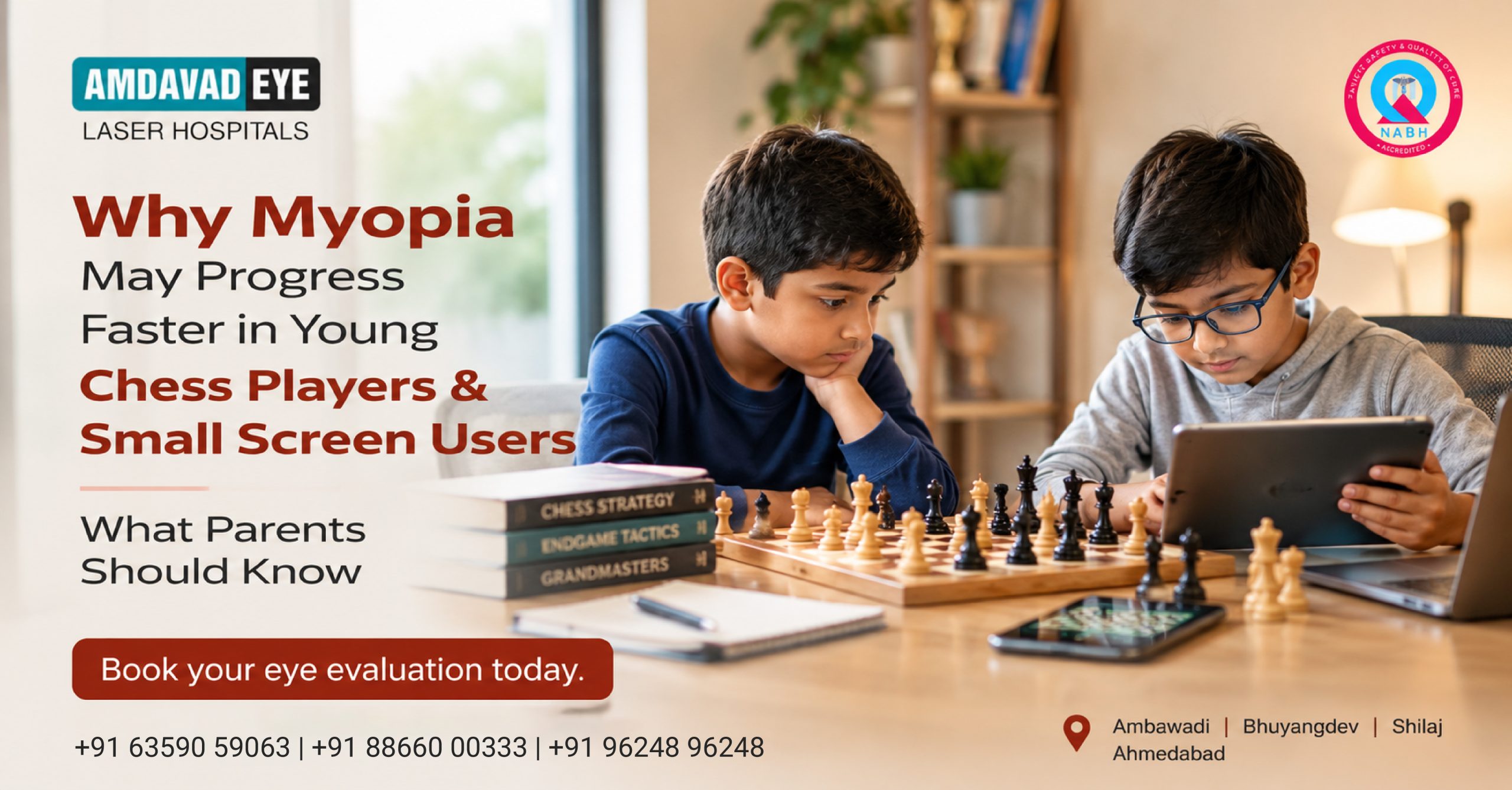
Why Myopia May Progress Faster in Young Chess Players and Small-Screen Users: What Parents Should Know
Chess is more than just a game. It develops concentration, patience, logical thinking, and problem-solving skills in children. From school-level competitions to national chess tournaments, more young players are dedicating hours to mastering their strategies and improving their performance.
But while parents focus on sharpening their child’s chess skills, there’s another important aspect that deserves attention their eyesight.
Young chess players often spend long hours studying chessboards, solving puzzles, analyzing games on digital devices, and practicing indoors. These habits may overlap with lifestyle factors associated with myopia progression in children.
Does this mean playing chess causes myopia? Not necessarily. There is no conclusive evidence that chess itself causes nearsightedness or makes it progress faster. However, certain habits associated with intensive chess training may influence children’s visual health.
Let’s understand the connection and what parents can do to protect their child’s vision.
Understanding Myopia in Children
Myopia, commonly known as nearsightedness or short-sightedness, is a vision condition in which nearby objects appear clear while distant objects look blurry.
For example, a child with myopia may see the chess pieces directly in front of them clearly but struggle to read the classroom blackboard or recognize distant objects.
Myopia commonly develops when the eyeball grows longer than normal, causing incoming light to focus in front of the retina rather than directly on it.
Childhood myopia often progresses during the growing years, which means a child’s spectacle prescription may increase over time.
Common signs of myopia in children include:
- Difficulty seeing distant objects clearly
- Squinting while looking at the blackboard or television
- Sitting unusually close to screens
- Complaints of blurred distance vision
- Frequent changes in spectacle prescription
Recognizing these signs early and scheduling regular eye examinations can help parents manage their child’s vision more effectively.
Why Might Myopia Progress Faster in Young Chess Players?
Chess itself is not a proven cause of myopia progression. However, intensive training routines may involve several environmental and behavioral factors linked to childhood myopia.
1. Prolonged Near Work During Chess Practice
Chess requires sustained visual attention. Young players spend considerable time looking at chessboards, reading strategy books, solving puzzles, and studying different game positions.
These activities involve near work, meaning the eyes remain focused on objects at relatively close distances.
Research has found associations between certain near-work habits and childhood myopia, particularly when children work at very short viewing distances or continue without breaks.
While not every child who performs prolonged near work will develop myopia, encouraging healthier viewing habits is important.
2. Increased Screen Time From Online Chess
Online chess has transformed how children learn and compete. Many young players use smartphones, tablets, and computers to attend coaching sessions, watch tutorials, analyze matches, and participate in tournaments.
This can lead to extended periods of close-up screen viewing.
Although screen time alone has not been established as a direct cause of myopia progression, prolonged screen-based near work may contribute to an overall lifestyle associated with myopia risk.
Additionally, excessive screen use can cause digital eye strain, temporary blurred vision, dryness, and visual discomfort.
Parents should encourage regular breaks and maintain a healthy balance between online and offline chess practice.
3. Less Time Spent Outdoors
One of the most important factors associated with childhood myopia is insufficient outdoor activity.
Children who spend more time outdoors generally have a lower risk of developing myopia than those who spend most of their time indoors.
However, young chess enthusiasts may spend much of their free time attending coaching classes, preparing for tournaments, or practicing at home.
This can reduce the time available for outdoor play and natural daylight exposure.
Research suggests that outdoor activity plays a protective role in preventing the onset of myopia, although its ability to slow progression after myopia has already developed is less certain.
Encouraging approximately one to two hours of outdoor time daily, where practical, can be a helpful preventive habit.
4. Long Practice Sessions Without Visual Breaks
Competitive chess requires deep concentration. During a tournament or an intensive practice session, children may remain focused on the chessboard for extended periods.
Long periods of uninterrupted near work may contribute to visual fatigue and may be associated with myopia-related risk factors.
Parents can encourage the 20-20-20 rule: after every 20 minutes of close-up activity, look at something approximately 20 feet away for at least 20 seconds.
This habit can help reduce visual discomfort and eye strain, although it has not been proven by itself to prevent or slow myopia progression.
5. Genetic Factors and Early Onset of Myopia
Lifestyle is only one part of the picture.
Children with one or both parents who have myopia are at greater risk of developing the condition.
Additionally, children who develop myopia at a younger age may experience more years of progression as their eyes continue growing.
Therefore, increasing spectacle power should not automatically be blamed on chess practice, screen time, or studying.
A comprehensive eye examination can help identify whether a child’s myopia is progressing and whether specific management options should be considered.
Does Playing Chess Actually Damage Children’s Eyes?
No. Playing chess itself does not damage children’s eyes.
Chess is a valuable activity that supports cognitive development, concentration, and decision-making.
The concern is not the game, but the visual habits that may accompany intensive training.
A child who practices chess while taking breaks, maintaining a comfortable viewing distance, spending time outdoors, and receiving appropriate eye care can continue enjoying the game.
Parents should focus on building balanced routines rather than discouraging their child’s interest in chess.
7 Eye Care Tips Every Parent of a Young Chess Player Should Know
Protecting your child’s eyesight does not mean reducing their passion for chess. Small changes in everyday routines can support healthier visual habits.
1. Encourage Regular Eye Breaks
Teach your child to follow the 20-20-20 rule during chess study sessions, reading, and screen-based activities.
2. Maintain a Comfortable Viewing Distance
Encourage children to keep chessboards, books, and digital devices at a comfortable viewing distance, generally around 30–40 cm for typical close-up tasks.
Avoid holding smartphones or books excessively close to the eyes.
3. Make Outdoor Activities Part of the Daily Routine
Encourage outdoor play, walking, cycling, or sports alongside chess practice.
Spending time outdoors is associated with a reduced risk of developing childhood myopia.
4. Balance Online and Offline Chess Practice
Where possible, alternate digital chess training with physical chessboards.
This may help reduce continuous screen exposure, although physical chess remains a near-work activity.
5. Ensure Proper Lighting
Children should practice in a well-lit environment without excessive glare.
Comfortable lighting can reduce visual discomfort during prolonged reading or chess sessions.
6. Watch for Early Warning Signs
If your child frequently squints, moves closer to the television, or complains of difficulty seeing distant objects, schedule an eye examination.
7. Schedule Regular Eye Check-Ups
Children with diagnosed myopia should undergo regular eye examinations according to their ophthalmologist’s advice.
For children with progressive myopia, follow-up examinations may be recommended approximately every six months, depending on individual needs.
Can Myopia Progression in Children Be Controlled?
While myopia cannot always be prevented or stopped completely, modern eye care offers several evidence-based approaches that may help slow its progression.
Depending on a child’s age, eye prescription, eye growth, and clinical findings, an ophthalmologist may consider:
Myopia-control spectacle lenses: Specially designed lenses may help slow progression in suitable children.
Low-dose atropine eye drops: These may be prescribed in selected cases under ophthalmologist supervision. Effectiveness varies with concentration and individual response.
Specialized contact lenses: Certain contact lens designs and orthokeratology may be appropriate for selected children under professional supervision.
Lifestyle guidance: Encouraging sufficient outdoor activity, comfortable viewing distances, and regular breaks supports healthy visual habits.
Regular monitoring: Tracking spectacle prescription and, where appropriate, the length of the eyeball helps ophthalmologists assess progression.
The most suitable approach depends on the child’s individual eye health and should be determined through professional examination.
When Should You Consult an Eye Specialist for Your Child?
Parents should consider consulting an ophthalmologist if their child:
- Has difficulty reading the classroom blackboard
- Experiences frequent increases in spectacle power
- Squints while looking at distant objects
- Has a family history of myopia
- Complains of persistent blurred vision
- Has already been diagnosed with progressive myopia
Early evaluation is particularly important because myopia can progress throughout childhood and adolescence.
Higher levels of myopia are associated with an increased lifetime risk of certain eye conditions, including retinal detachment, myopic maculopathy, and glaucoma.
Timely assessment and appropriate management may help reduce future risks associated with increasing myopia.
Children’s Eye Care at Amdavad Eye Laser Hospitals, Ahmedabad
At Amdavad Eye Laser Hospitals, we understand how important clear vision is for a child’s learning, confidence, and overall development.
With over 30 years of experience in eye care, Amdavad Eye Laser Hospitals provides comprehensive ophthalmic services, including children’s eye examinations and paediatric eye care.
Whether your child is a passionate chess player, spends long hours studying, or has recently experienced changes in spectacle power, an eye examination can help identify vision concerns and guide appropriate management.
Parents can learn more about our eye care facilities or contact our team to arrange a consultation.
Our Ahmedabad Centres: Ambawadi | Bhuyangdev | Shilaj
For Appointments: 7069069077
Frequently Asked Questions About Chess and Myopia
1. Can playing chess cause myopia in children?
There is no conclusive scientific evidence that chess directly causes myopia. However, prolonged near work and insufficient outdoor activity may contribute to lifestyle-related risk factors for childhood myopia.
2. Why is my child’s spectacle power increasing every year?
Myopia can progress as children’s eyes grow. Genetics, younger age at onset, and environmental factors may influence progression. An eye examination can help determine the rate of change.
3. Is online chess worse for eyesight than playing on a physical chessboard?
Online chess involves screen viewing, which can contribute to digital eye strain. Both online and physical chess involve near work, so maintaining comfortable viewing distances and taking regular breaks is advisable.
4. Can outdoor activities prevent myopia?
Research shows that spending more time outdoors can reduce the risk of developing myopia in children. However, outdoor activities cannot guarantee prevention and may not substantially slow progression in children who are already myopic.
5. Can myopia progression be stopped permanently?
There is no universally effective treatment that permanently stops myopia progression in every child. However, several evidence-based treatments can help slow progression in suitable cases.
6. How often should a young chess player have an eye examination?
Children with myopia should follow their ophthalmologist’s recommended examination schedule. Those with progressive myopia may need more frequent monitoring, often around every six months.
Conclusion: Let Your Child Master Chess Without Overlooking Eye Health
Chess teaches children to think ahead, stay focused, and make smart decisions. The same approach should apply to protecting their eyesight.
While chess itself does not cause myopia, intensive near-work routines, excessive screen use, and limited outdoor activity may create conditions associated with childhood myopia risk.
By encouraging regular breaks, outdoor play, healthy viewing habits, and timely eye examinations, parents can support both their child’s passion for chess and their long-term vision.
Your child may be planning their next winning move. Make sure their eye health is part of the strategy, too.
If you have noticed changes in your child’s vision or increasing spectacle power, schedule a comprehensive eye examination at Amdavad Eye Laser Hospitals, Ahmedabad.
Call 7069069077 | 6359059063 to book an appointment.
Recent Post
-
Why Myopia May…29 Oct 2026
-
 Reading Glasses Removal…19 Oct 2026
