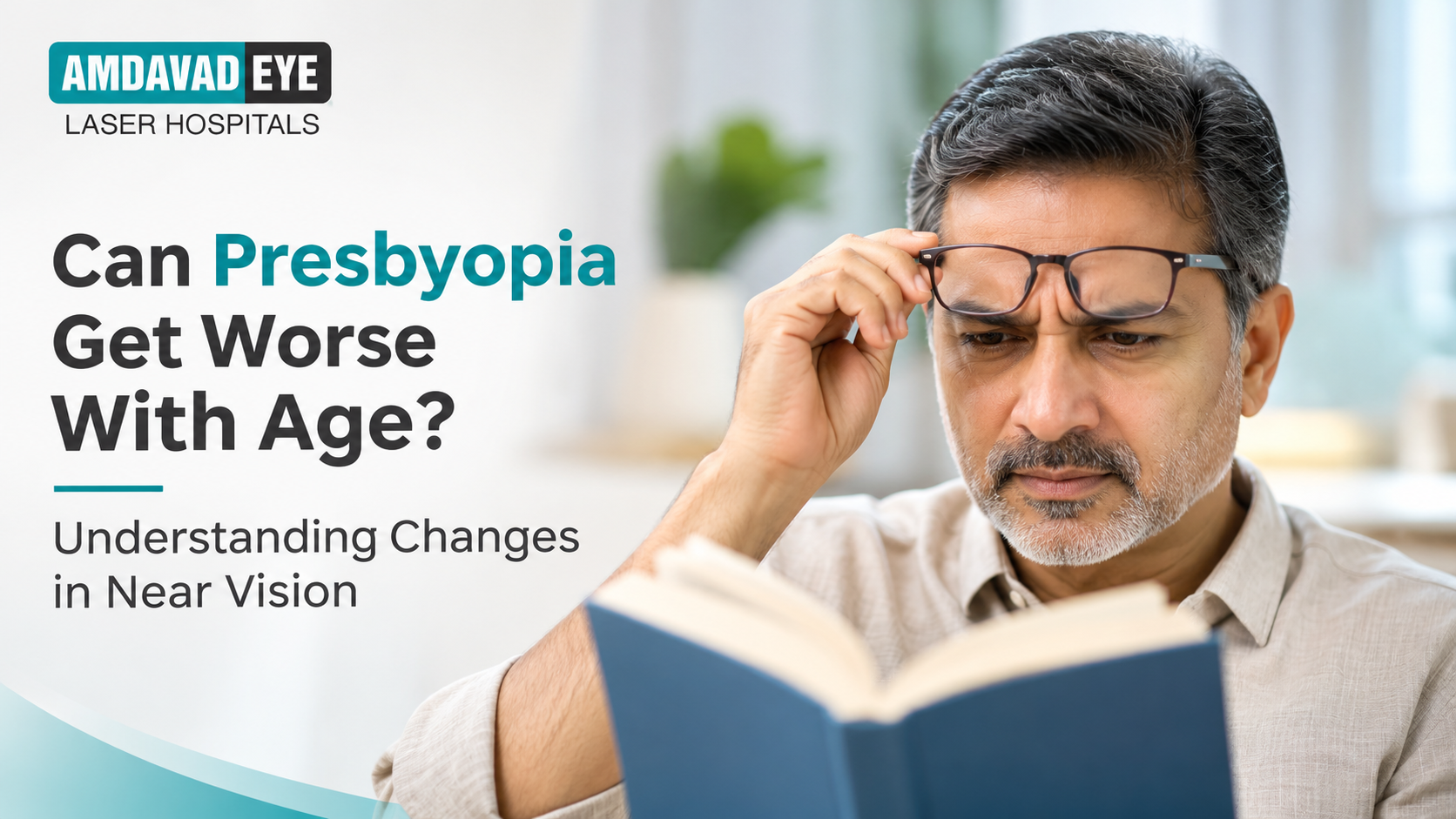
Can Presbyopia Get Worse With Age? Understanding Changes in Near Vision
Have you noticed that reading small text on your smartphone, books, or newspapers is becoming increasingly difficult as you get older? Do you find yourself holding your phone farther away to see the words clearly? These changes may indicate presbyopia, a common age-related vision condition that affects the ability to focus on nearby objects.
One of the most common questions people ask after noticing these symptoms is: Can presbyopia get worse with age?
The answer is yes. Presbyopia generally progresses gradually with age, particularly between the early 40s and mid-60s. As the natural crystalline lens inside the eye becomes harder and less flexible, its ability to change shape during near focusing decreases. This makes activities such as reading, using smartphones, and working on computers increasingly challenging.
Understanding how presbyopia progresses, recognizing its early symptoms, and exploring available treatment options can help you maintain comfortable vision at different distances.
1. What Is Presbyopia?
Presbyopia is an age-related vision condition in which the eyes gradually lose their ability to focus on nearby objects. It occurs because the natural crystalline lens becomes less flexible over time.
In a younger eye, the crystalline lens changes its curvature to increase optical power when focusing on close objects. This process is called accommodation.
As the lens ages, it becomes stiffer and cannot change its shape as effectively. Consequently, the eye struggles to focus clearly on nearby objects.
Common symptoms of presbyopia include:
- Difficulty reading small print at a normal distance.
- Holding smartphones, books, or newspapers farther away.
- Blurred vision when looking at nearby objects.
- Eye strain during prolonged reading.
- Headaches after close-up activities.
- Needing brighter lighting for comfortable reading.
- Difficulty shifting focus between distant and nearby objects.
Presbyopia is a natural part of aging and can affect almost everyone eventually, regardless of whether they previously had perfect vision.
2. Can Presbyopia Get Worse With Age?
Yes. Presbyopia typically progresses with age because the crystalline lens continues to lose flexibility and elasticity.
The reduction in accommodative ability begins much earlier in life, but symptoms usually become noticeable around the early to mid-40s.
As the condition progresses, people may experience increasing difficulty performing near-vision activities.
The progression generally follows these stages:
Early 40s: Initial Symptoms
- Difficulty reading small text.
- Holding reading material farther away.
- Increased dependence on good lighting.
- Occasional eye strain during near work.
Late 40s to Early 50s: Increasing Near-Vision Difficulty
- Reading at normal distances becomes more challenging.
- Reading glasses may become necessary.
- Prolonged smartphone and computer use may cause discomfort.
- Near-vision prescriptions may need adjustment.
Mid-50s to Early 60s: Advanced Presbyopia
- Near focusing ability becomes significantly reduced.
- Stronger near additions may be required.
- Reading and other close-up tasks may become difficult without appropriate correction.
After the Mid-60s: Relative Stabilization
Presbyopia generally approaches a relatively stable stage as the eye’s remaining accommodative ability becomes minimal. However, changes in spectacle prescriptions can still occur because of other age-related eye conditions or refractive changes.
The exact progression differs from person to person.
3. Why Does Near Vision Become Worse as You Get Older?
The primary reason presbyopia progresses is the gradual change in the structure and biomechanical properties of the crystalline lens.
Several changes contribute to this process:
A. Loss of Lens Flexibility
The crystalline lens becomes progressively stiffer with age. It cannot increase its curvature sufficiently during accommodation, reducing the eye’s ability to focus on nearby objects.
B. Continuous Lens Growth
Lens fibers accumulate throughout life. This contributes to changes in lens thickness, structure, and mechanical properties.
C. Changes in Lens Proteins
Age-related biochemical changes in lens proteins influence the transparency and biomechanical characteristics of the lens.
D. Reduced Accommodative Amplitude
Accommodative amplitude refers to the maximum focusing power the eye can generate when viewing near objects.
As the lens becomes less flexible, accommodative amplitude gradually decreases. Eventually, the available focusing power becomes insufficient for comfortable reading at normal distances.
Importantly, the ciliary muscle continues to participate in accommodation. The aging lens becomes increasingly resistant to deformation, limiting the effectiveness of the focusing mechanism.
4. Why Do You Hold Your Smartphone Farther Away After 40?
Holding your smartphone farther away is one of the most recognizable symptoms of developing presbyopia.
This happens because increasing the distance between your eyes and the screen reduces the amount of accommodation required to focus on the text.
For example:
- At 25 cm, the accommodative demand is approximately 4.00 diopters.
- At 33 cm, it is approximately 3.00 diopters.
- At 40 cm, it is approximately 2.50 diopters.
- At 50 cm, it is approximately 2.00 diopters.
These are approximate values for an emmetropic eye.
As your accommodative ability decreases, reading at close distances becomes more difficult. Moving your phone farther away reduces the focusing demand and may temporarily make the text clearer.
However, this adjustment cannot permanently correct presbyopia.
5. Does Presbyopia Progress at the Same Rate in Everyone?
No. Although presbyopia is a common age-related condition, its symptoms and progression can vary between individuals.
Several factors influence how noticeable it becomes:
Refractive Error
- Myopia (nearsightedness): People with myopia may find it easier to read nearby objects without distance glasses, depending on their prescription.
- Hyperopia (farsightedness): People with hyperopia may notice near-vision difficulties earlier because they already use accommodation to compensate for their refractive error.
- Astigmatism: Uncorrected astigmatism can contribute to blurred vision at both near and far distances.
Visual Requirements
People who spend several hours reading, using smartphones, or performing detailed close-up work may notice presbyopia symptoms more frequently.
Lighting Conditions
Poor illumination can make small print more difficult to read, particularly when accommodative ability is already reduced.
Individual Differences
Age-related changes in lens structure and accommodative function vary between individuals, influencing when symptoms become noticeable.
6. What Are the Best Treatment Options for Progressive Presbyopia?
Although presbyopia cannot be prevented through exercises or lifestyle changes, several effective treatments can improve near vision.
The appropriate option depends on age, refractive error, lifestyle, visual requirements, and overall eye health.
A. Reading Glasses
Reading glasses are one of the simplest and most commonly used treatments for presbyopia.
They provide additional plus power to help the eyes focus on nearby objects.
B. Bifocal Glasses
Bifocal lenses contain separate optical zones for distance and near vision, allowing patients to see clearly at different distances.
C. Progressive Addition Lenses (PALs)
Progressive lenses provide a gradual transition between distance, intermediate, and near vision without visible dividing lines.
They are useful for people who require correction for multiple viewing distances.
D. Multifocal Contact Lenses
Multifocal contact lenses contain different optical zones designed to support vision at near, intermediate, and far distances.
E. Monovision Contact Lenses
Monovision involves correcting one eye primarily for distance vision and the other primarily for near vision.
A trial is generally recommended to evaluate comfort and adaptation.
7. Can Presbyopia Be Treated Without Glasses?
Yes. Several medical and surgical options may reduce dependence on reading glasses in appropriately selected patients.
These include:
- Presbyopia-correcting eye drops: Certain prescription medications temporarily improve near vision by constricting the pupil and increasing depth of focus.
- Corneal refractive procedures: Selected procedures can create a monovision effect or modify corneal optics.
- Multifocal intraocular lenses: These artificial lenses provide different focal zones to improve vision at multiple distances.
- Extended Depth of Focus (EDOF) lenses: These lens designs aim to provide an extended range of vision, particularly distance and intermediate vision, with varying near-vision performance.
- Refractive lens exchange: The natural crystalline lens is surgically replaced with an artificial intraocular lens.
Every treatment has potential benefits, limitations, and risks. Not all options restore natural accommodation, and surgical procedures require careful evaluation by an ophthalmologist.
8. Can You Slow Down or Prevent Presbyopia?
Currently, there is no scientifically established way to prevent or permanently stop the natural progression of presbyopia.
However, certain habits can help improve reading comfort and reduce associated visual discomfort.
Consider these practical tips:
- Maintain comfortable reading distances.
- Use adequate lighting when reading.
- Take regular breaks during prolonged screen use.
- Adjust smartphone font size for easier reading.
- Avoid prolonged reading in poorly illuminated environments.
- Schedule routine comprehensive eye examinations.
- Use the appropriate spectacle prescription when required.
The 20-20-20 rule can also help reduce digital eye strain: every 20 minutes, look at something approximately 20 feet away for 20 seconds.
However, these habits do not reverse the age-related loss of accommodation.
9. When Should You Consult an Eye Specialist?
Gradual difficulty reading nearby objects after age 40 is commonly associated with presbyopia. However, not every change in near vision is caused by normal aging.
You should schedule a comprehensive eye examination if you experience:
- Increasing difficulty reading at your usual distance.
- Frequent changes in your reading-glass prescription.
- Persistent headaches during near work.
- Blurred vision despite wearing prescribed spectacles.
- Difficulty focusing between near and distant objects.
- Sudden or unexplained changes in vision.
An eye examination helps assess visual acuity, refractive errors, accommodation, and overall eye health.
Sudden vision loss, new flashes or floaters, or a curtain-like shadow in your vision requires urgent medical assessment rather than waiting for a routine appointment.
10. Frequently Asked Questions About Presbyopia
Does presbyopia get worse every year?
Presbyopia generally progresses gradually throughout the 40s and 50s as the natural lens becomes less flexible. It usually approaches a relatively stable stage around the mid-60s, although individual experiences vary.
At what age does presbyopia stop progressing?
Presbyopia generally stabilizes around the mid-60s because the remaining accommodative ability becomes minimal. However, other age-related eye changes can continue to affect vision.
Can presbyopia cause permanent vision loss?
No. Presbyopia itself does not cause blindness or permanent retinal damage. It affects the eye’s ability to focus on nearby objects and can generally be corrected with appropriate optical or medical treatment.
Can eye exercises reverse presbyopia?
No. Eye exercises cannot restore the natural flexibility of an aging crystalline lens. They may help with certain visual comfort issues but do not reverse presbyopia.
Why do I need stronger reading glasses as I get older?
As accommodative ability decreases, the eyes require additional optical power to focus comfortably on nearby objects. This is why the near addition in reading glasses may increase during the progression of presbyopia.
Is presbyopia the same as farsightedness?
No. Presbyopia is an age-related reduction in accommodation, whereas hyperopia is a refractive error caused by the eye’s optical focusing characteristics. Both conditions can occur together.
Conclusion
Presbyopia is a natural age-related change that gradually reduces the eye’s ability to focus on nearby objects. As the crystalline lens becomes harder and less flexible, reading small text, using smartphones, and performing close-up activities can become increasingly difficult.
Although presbyopia generally progresses throughout the 40s and 50s, effective correction options are available, including reading glasses, progressive lenses, multifocal contact lenses, prescription eye drops, and selected surgical procedures.
Recognizing early symptoms and scheduling regular eye examinations can help you choose the most appropriate treatment for comfortable near vision.
Clear near vision is important at every age. If you are noticing changes in your reading vision, consult an eye-care professional for a comprehensive evaluation.
Recent Post
-
 Retina Problems: Early…18 Nov 2026
-
Can Presbyopia Get…04 Nov 2026
